Key Insights
Quick Facts
- Name: State Highway 61 Chip Seal Project
- Location: Ogallala, Nebraska
- Client: Nebraska Department of Transportation (NDOT)
- Size: CRS-2P emulsion, CSS-1H 50 fog seal, expanded shale lightweight aggregate
- Our Solution: Supplied high-retention, angular-faced lightweight aggregate to ensure effective sealing, prevent road wear, and reduce maintenance needs.
- Why Lightweight Works: Lightweight aggregate maintains excellent skid resistance, and reduces shipping costs due to its low density.
Final Results
-
Successfully extended pavement life with minimal aggregate loss, high skid resistance, and reduced maintenance costs. The success led to the expansion of this technique across an additional eight miles.
Key Quote
Context:
- Considerations: Lightweight aggregate’s angular structure provides better retention compared to round-faced aggregates, making it ideal for Nebraska’s challenging conditions.
- Lessons Learned: Lightweight aggregate with angular faces provides long-term performance and cost savings in chip seal applications, even in regions with limited local aggregate options.
Chipseal Delivers Economy, Longer Lasting Roads in Nebraska Project
State Highway 61, just south of Ogallala, Nebraska, often utilizes expanded shale lightweight aggregate from Arcosa Lightweight. “In this day and age, it’s all about preserving the life of the pavement,” says Matt Radke, former Maintenance Supervisor for the Nebraska Department of Transportation (NDOT).
“They moved to a program of more frequent maintenance. It’s about keeping water out of the asphalt.”
Now a Grading Foreman at Morris Inc. in South Dakota, Radke spent over 23 years as a highway maintenance supervisor with NDOT. Radke, a Professional Engineer, moved from Nebraska to Pierre, South Dakota in 2020 to be closer to his family.
The Process
Chip seals are a technique used to extend the life of asphalt pavements. The process begins with an even application of hot emulsion over existing pavement, followed by an even distribution of well-graded aggregate. For the Highway 61 project, NDOT used an innovative technique involving a heavier application of emulsion, followed by a second round of fogging with emulsion after a 10-day curing period.
“We shot the emulsion at a considerably heavier rate than we normally do with chip seals, and then we applied the fog coating of emulsion,” Radke explains. This method has proven effective, with the project holding up well through the challenging Nebraska winter.
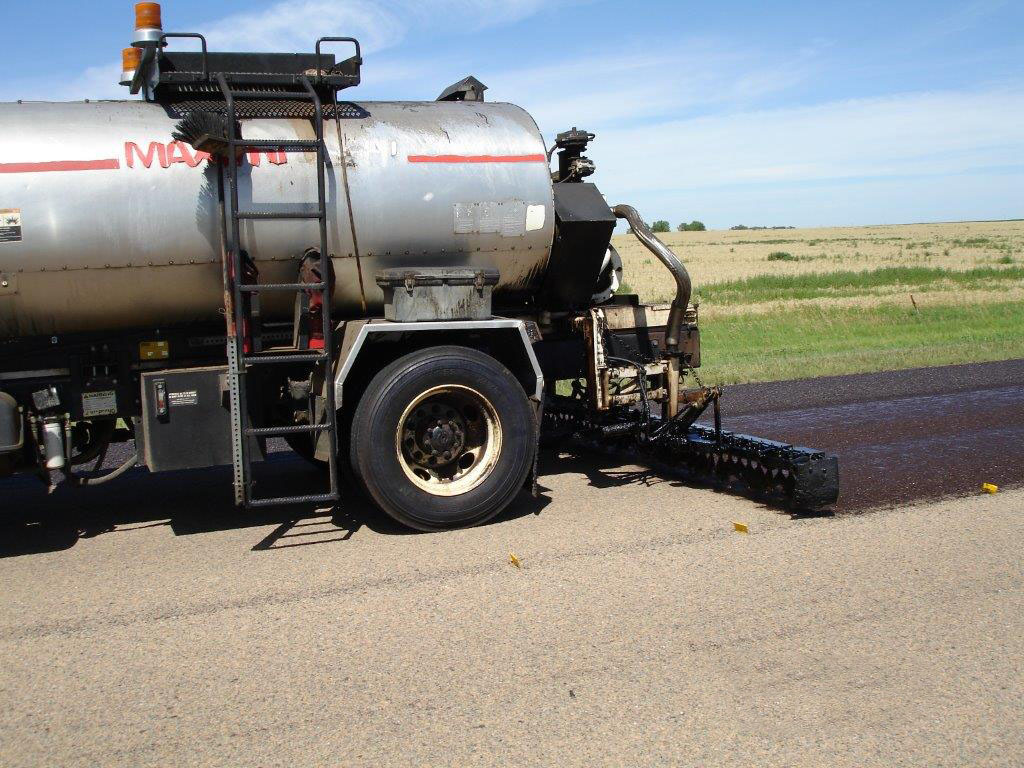
Completed in June 2015, the project has maintained its appearance and performance, with minimal aggregate loss and color change. “It’s held up very well, with very little loss of aggregate and very little change in color.” Because of the success of this project, NDOT later installed another eight miles of road with the same technique.
The initial emulsion, CRS-2P, was applied at a rate of 0.43 gallons per square yard, and the expanded shale was applied at an average of 14 to 15 lbs. per square yard. “We started the application at 18 pounds per square yard and dropped the rate until we had no loose material on top,” Radke explains.
“Compaction was key,” he adds. “We ran three rollers. The roller operators were instructed to never stop rolling, even while waiting for oil. We had them roll the entire length of the surface we had covered. We also didn’t sweep anything until the next day. What had been loose material the day before was now embedded in the oil.” After the chip seal had cured for 10 days, a fog seal of CSS-1H 50 was applied at the rate of 0.14 gallons per square yard.
Angular-Faced Aggregate Means Better Retention
In north and central Nebraska, the supply of locally available coarse aggregate is very limited. The available aggregate is typically river rock, which is spherical and not ideal for use in road sealing projects. Spherical or round-faced aggregates come loose more easily, leading to chipped windshields and reduced pavement life.
The angular faces of lightweight aggregates, by contrast, provide higher retention rates and longer-lasting pavements. “The angular-faced aggregate seems to sit tighter, with better retention,” Radke says. Additionally, lightweight aggregate particles are less likely to chip windshields if they do come loose.
Lightweight Aggregate Means Reduced Shipping Costs
When non-local aggregate must be transported, weight significantly impacts shipping costs. Arcosa’s lightweight aggregate, with half the density of conventional gravel, provides a cost-effective solution. Its lighter weight enables the higher-performance material to be shipped over longer distances without breaking the budget.