Key Insights

Quick Facts
- Name: 1.5-Mile Bike Trail Project
- Location: Orland Park, Illinois
- Customer: D Construction
- Client: Public Works / Local Municipality
- Size: 1.5 miles
- Our Solution: Arcosa Lightweight provided a fine gradation of lightweight aggregate (LWA) to reduce pressure on compressible soils and support slope stability using the Tensar Sierra® Slope Retention System.
- Why Lightweight Works: Arcosa Lightweight’s LWA was key in reducing stress on poor subgrades, minimizing lateral pressure, and providing a stable foundation despite challenging site conditions.
Final Results
-
The project was successfully completed, with the lightweight aggregate contributing to both soil stabilization and slope management. The lightweight material met all specifications and improved the construction process.
Key Quote
Context:
- Considerations: Lightweight aggregate was chosen due to its ability to address both soil compression and slope stability challenges. The project required precise layering of the aggregate with geogrids to ensure long-term stability.
- Lessons Learned: Using lightweight aggregate in challenging terrain offers significant benefits in reducing pressure on poor soils while providing slope stability.
Learn more about how Arcosa Lightweight aggregates contribute to construction projects with complex soil and slope conditions.
Expanded Bike Trail Benefits from Innovative Use of Lightweight Aggregate
Bike riders in Orland Park, IL, a suburb near Chicago, have an expanded bike trail thanks to Arcosa’s lightweight aggregate, supplied by the company’s Brooklyn, Indiana plant. Orland Park is a growing area committed to improving recreational facilities for its citizens.
A New 1.5-Mile Bike Trail Overcomes Challenging Terrain
A new 1.5-mile bike trail, connecting two existing trails, was constructed through challenging terrain. “The site of the trail is in a swampy, marshy area bordering a large drainage ditch and a pond,” says Jack Moore, Arcosa’s geotechnical market manager. “There was also a steep slope running alongside the trail to contend with.”
“The road parallel to the bike path had been widened roughly a decade ago. Back then, developers found expanded shale lightweight aggregate (LWA) to be the perfect solution for similar challenging site conditions, and as it turns out, lightweight would once again come into play,” says Wolfe.
Two Challenges: Poor Soil and a Steep Slope
A subsurface investigation by the owner’s geotechnical engineer revealed layers of compressible soils just below the existing grade, precisely where the embankment for the newly widened path would need to go.
To address settlement concerns, the geotechnical engineer recommended using lightweight aggregate (LWA) with no more than 70 pounds per cubic foot density. Such a low-density granular fill would reduce applied pressures on the compressible soils. However, the slope still needed to be managed.
“A reinforced slope system, called Tensar Sierra® Slope, was chosen to deal with that challenge,” Moore says. “Arcosa Lightweight was placed in the reinforced fill zone of the Sierra system. Combining our lightweight with Tensar’s system addressed both the poor soil and the steep slope needed to accommodate right-of-way limitations. Using our granular lightweight fill was the best option for the project,” he adds.
Details on Tensar’s Sierra® Slope Retention System
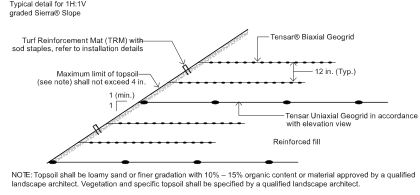
Tensar’s Sierra Slope System is an ideal and economical option when steeper slopes are needed due to right of way limitations or other constraints. The system can significantly reduce material and installation costs by eliminating many limitations imposed by soil conditions and minimizing fill requirements.
The geosynthetic material is layered in with the lightweight fill to provide slope stability. According to Tensar’s design engineer on the project, Vikas Cinnam, Tensar geogrids can be installed as an infill in almost any environment.
“That includes organic soils, saline soils, modified soils, alkaline soils, acidic soils, and soils with transition metals as long as the pH is greater than 3,” says Cinnam. “So, the use of lightweight is one example regarding the flexibility of Tensar systems,” he says.
Working With the Contractor
The contractor, D Construction of Coal City, IL, originally planned to use coarse lightweight aggregate on the project.
But Moore demonstrated that Arcosa’s fine gradation of lightweight aggregate would work equally well and fully meet all the project’s technical specification requirements.
“The slope on the side of the path was pretty steep,” says Chris Piazza of D Construction. “That made the job a challenge, and we had to layer the aggregate with the grid from the Sierra Slope system.”
“Arcosa did a fantastic job of helping us specify the right aggregate and got it there on time,” Piazza says.
Moore highlights that Arcosa Lightweight’s aggregate, with its lower density and higher internal friction angle, is ideally suited for challenging applications.
“In these situations, lightweight aggregate reduces the stress on poor subgrades,” Moore explains. “Its high internal friction angle and lower density also help decrease the lateral earth pressure on the system.”