Key Insights
Quick Facts
- Name: KDOT Bridge Deck Study
- Location: Olathe, Kansas
- Client: Kansas Department of Transportation (KDOT)
- Size: 450-foot bridge deck
- Our Solution: Arcosa supplied pre-wetted fine lightweight aggregate for the concrete mix. The aggregate retains moisture, enabling internal curing, which helps maintain optimal hydration and reduces shrinkage in the concrete.
- Why Lightweight Works: The lightweight aggregate ensures that the concrete maintains internal moisture, preventing early-age desiccation and reducing the likelihood of cracking. This helps the bridge deck resist chloride penetration and extends its lifespan.
Final Results
-
KDOT placed 800 cubic yards of internally cured concrete in a continuous pour. Sensors embedded in the deck monitor temperature and strength development, providing real-time data to evaluate the concrete’s performance and the benefits of internal curing.
Key Quote
Context:
- Considerations: The KDOT study is closely monitoring the bridge deck through embedded sensors to assess the performance of internally cured concrete. This approach, using lightweight aggregate, aims to reduce cracking and increase the long-term durability of the bridge.
- Lessons Learned: Internally cured concrete, facilitated by lightweight aggregate, helps prevent early-age shrinkage and cracking, improving the durability and service life of bridge decks.
Arcosa Lightweight’s pre-wetted fine aggregate provides a proven solution for infrastructure projects that require enhanced durability and resistance to cracking, making it a valuable choice for bridge decks and other applications.
Kansas Department of Transportation (KDOT) Bridge Deck Study: Advancing the Use of Internal Curing
Since 2016, the Kansas Department of Transportation (KDOT), along with the University of Kansas (KU) and the State of Minnesota, has been studying the use of internal curing to improve bridge deck service life. Traditional concrete bridge decks, with their high cementitious materials content and low water-to-cement ratio, are prone to early age cracking and self-desiccation.
Phase one of the study evaluated internal curing (IC) with 100% portland cement concrete mixtures. In this phase, IC was combined with supplementary cementitious materials (SCMs).
The bridge, located near Olathe, Kansas, uses a concrete mix that includes pre-wetted fine lightweight aggregate from Arcosa, along with slag and silica fume. The goal is to reduce early age cracking and improve resistance to chloride penetration, which leads to deterioration. Dan Wadley, Chief of the Bureau of Research for the Kansas Department of Transportation, is overseeing the study, along with Dr. David Darwin, chairman of KU’s Department of Civil, Environmental & Architectural Engineering.
Careful Monitoring
Six months after completion, Wadley spot-checked the decking of the 450-foot structure, looking for signs of premature cracking and gathering data using embedded sensors. These sensors, installed during the September 2021 placement of the internally cured concrete, transmit data on variables such as temperature, helping researchers track strength gain through a maturity curve.
“As part of the research into internal curing that KDOT is doing, they installed sensors in the concrete that record different variables such as temperature, which they can use to calculate strength gain with a maturity curve,” explains Daron Brown, Midwest Regional Sales Manager at Arcosa Lightweight.
“That way, they can continue to monitor that bridge.”
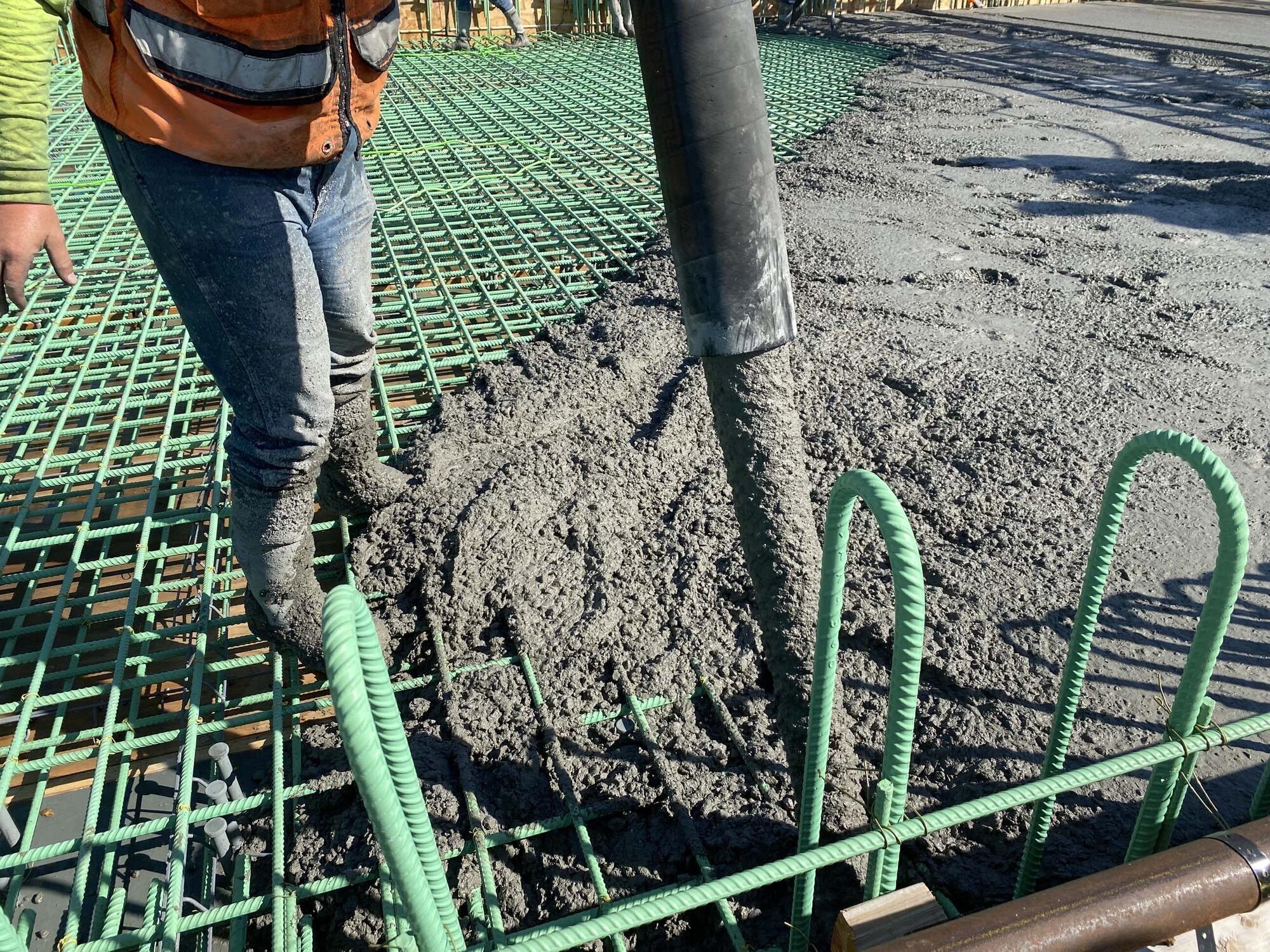
Pyramid Constructors placed approximately 800 cubic yards of concrete in one continuous pour that started at 3:30 AM and concluded 14 hours later at 5:15 PM. The concrete supplier, carefully controlled the concrete mix by adding ice to maintain the desired temperature range of the concrete, even as ambient temperatures fluctuated.
“The sensors helped us monitor the temperature of the deck as it cured,” says Wadley. “The ready mix producer did a great job keeping the mix consistent and adding the right amount of ice to keep the concrete temperatures in the 80s like we wanted.”
The success of this project highlights the importance of best construction practices to prevent cracking in bridge decks, particularly in the areas of consolidation, finishing, and curing.
Next Steps
As the study progresses, additional maturity tests and crack surveys will be conducted. The data collected will help refine specifications for Internally-Cured Low-Cracking High-Performance Concrete (IC-LC-HPC), with the ultimate goal of using internal curing more widely in various infrastructure projects.
“My hope is that we can use internal curing more frequently and on a wider range of applications simply because it works so well. On the paving side, it helps reduce curling and warping. On the bridge side, it reduces cracking quite a bit,” says Wadley.
Widespread Benefits
According to Daron Brown, many Departments of Transportation have seen similar results, with internal curing reducing premature cracking and extending the service life of concrete structures.
“They like the benefits it provides as far as producing a better concrete mixture. With less cracking, they’re going to get a longer service life out of their pavements or their bridge decks, wherever they decide to use it,” says Brown.