Key Insights
Quick Facts
- Name: Wilson Dam Renovation
- Location: Muscle Shoals, Alabama
- Customer: CEMEX / Ready Mix USA
- Client: Tennessee Valley Authority (TVA)
- Size: 100-year-old hydroelectric dam, major bridge deck renovation
- Our Solution: Arcosa supplied lightweight aggregate to CEMEX / Ready Mix USA, which produced internally cured concrete for the bridge deck. This innovative solution provided internal moisture that significantly improved the concrete’s strength, reduced cracking, and extended its service life.
- Why Lightweight Works: The lightweight fine aggregate used in the internally cured concrete helped retain moisture, allowing for a longer hydration process. This improved the mechanical performance of the concrete, ensuring increased durability and reduced maintenance needs over time.
Final Results
-
Over 30,000 cubic yards of internally cured concrete were produced using Arcosa’s lightweight aggregate. The newly restored bridge deck, completed in December 2020, gains enhanced performance and durability.
Key Quote
Context:
- Considerations: Internally cured concrete allowed TVA to improve the bridge deck’s strength and durability while addressing long-term maintenance concerns. The lightweight aggregate provided the necessary moisture for internal curing, preventing early-age shrinkage and reducing cracking.
- Lessons Learned: Using lightweight aggregate for internally cured concrete offers long-term benefits, including increased lifespan, reduced cracking, and overall lower maintenance costs, making it ideal for large-scale infrastructure projects.
Arcosa Lightweight’s solutions are ideal for projects requiring enhanced concrete durability and performance, particularly in historic renovations and critical infrastructure applications.
TVA Utilizes Internal Curing for Historic Hydroelectric Dam’s Bridge Deck
The Wilson Dam bridge deck, part of the iconic 100-year-old hydroelectric dam on the Tennessee River in Muscle Shoals, Alabama, is ready handle another century of traffic. Arcosa Lightweight’s material played a pivotal role in these extensive repairs, ensuring the bridge’s longevity by supporting the Tennessee Valley Authority’s (TVA) first-ever use of internally cured concrete.
This innovative solution will help the historic structure stand the test of time, offering enhanced durability and resilience.
“Our goal was to provide a 100-year bridge deck, and internal curing is a great way to achieve that,” explains Benjamin Byard, Bridge Program Manager at TVA. “Because you keep the internal relative humidity high much longer, you get increased strength before the concrete starts to desiccate. The combination of better strength and delayed drying shrinkage gives you a denser, better concrete. The decrease in cracking and increase in mechanical performance are the values of internal curing.”
Byard also highlighted the new surface, saying,
“The new surface is composed of reinforced ‘internally cured’ concrete, which should stand the test of time.”
Renovation Overview
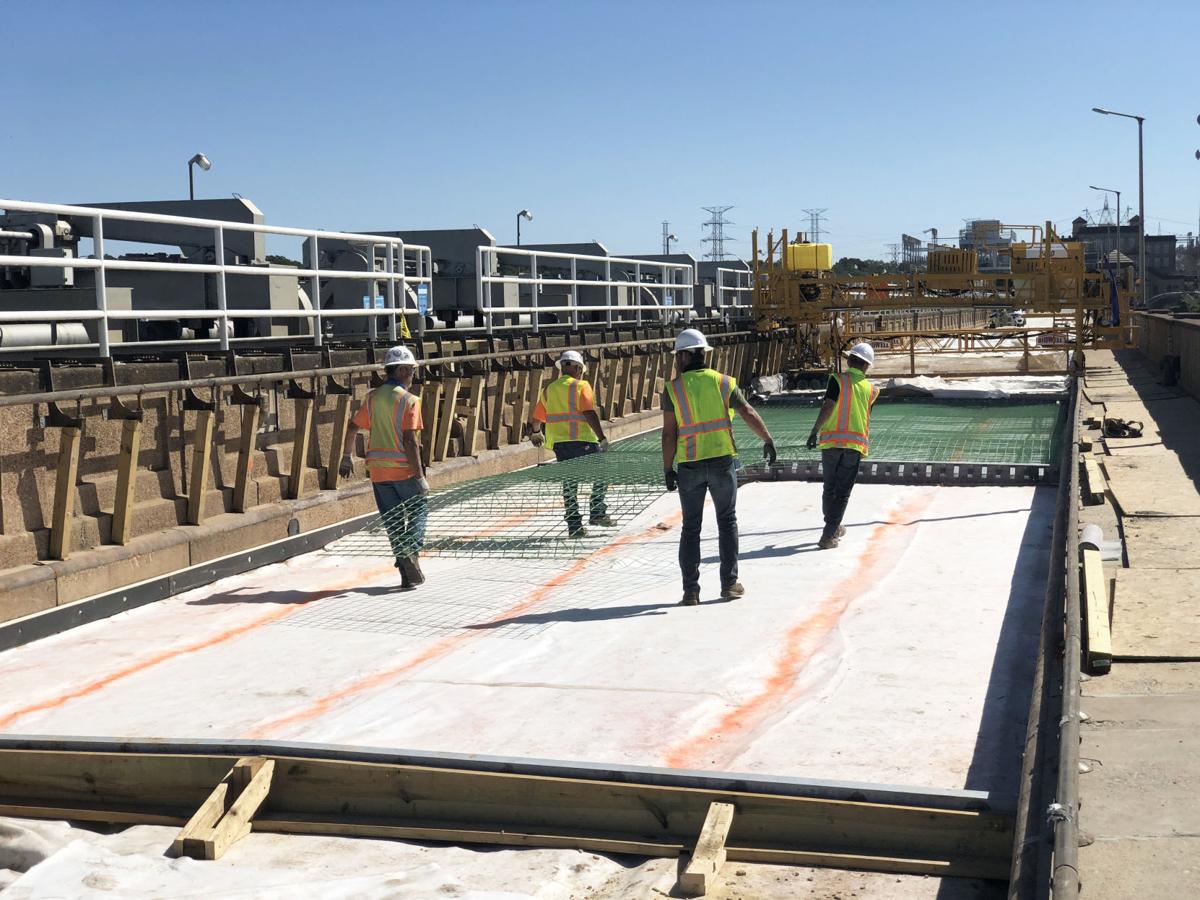
The Wilson Dam project included renovations to the dam structure, power-generating equipment, and significant bridge deck repairs. The bridge atop the dam connects Colbert and Lauderdale Counties and was originally constructed between 1918 and 1924. Though traffic slowed after the opening of the nearby Patton Island Bridge in 2008, TVA officials were eager to replace the 1950s-era concrete pavement.
“When the driving surface was removed in 2019, extensive damage was found. Cracks formed in the unreinforced concrete, allowing water to infiltrate and cause deterioration,” explains Byard. This led to the decision to resurface the bridge with internally cured concrete to extend its lifespan and reduce future maintenance needs.
Local Supplier
Matthew Moore, Quality Control Lead at CEMEX for the North Alabama region, says Ready Mix USA has extensive experience batching concrete with lightweight aggregate, most recently on a major new hospital which opened very near the Wilson Dam. But this project was somewhat unique. “We’ve used a lot of lightweight aggregate through the years and this project was a little different,” says Moore. “Basically, the internally cured concrete is designed to a weight and to an air spec and like I said, we have to take a little more care with the lightweight and make sure it’s kept wet at the plant.”
“The material does require additional handling, storage, and keeping it wet,” says Moore. “It has over 20% absorption, compared to about 1% for normal aggregates, so we closely monitored the moisture content and its impact on the mix.”
The concrete used in the renovation was batched from Ready Mix USA’s Florence Industrial Park plant. “For this job, we used the Florence plant on the north side of the river as our main facility, with Tuscumbia on the south side as backup,” says Moore.
Specifying Internal Curing
“It’s lightweight fine aggregate, similar to sand, that’s pre-soaked before batching the concrete,” explains Bill Wolfe, Marketing & Technical Manager at Arcosa Lightweight. “By replacing a portion of the concrete sand with pre-wet lightweight aggregate, internal moisture is provided to keep the hydration process going longer as the concrete cures.”
Wolfe also emphasized the performance benefits: “Internal curing reduces early-age shrinkage, which helps reduce cracking in the pavement and extends the service life of the structure.”
A Special Landmark
The Wilson Dam region is significant for the TVA, as it was the agency’s original headquarters when founded in 1933. “Helping restore Wilson Dam, the only neoclassical-style dam built by the U.S. Army Corps of Engineers in the TVA system, has been the highlight of my career,” says Byard.
The bridge reopened to traffic in December 2020, following completion of the renovations. Byard is confident in the project’s success: “If I’m doing a bridge deck, by golly, it’s going to be internally cured. For a relatively minor increase in cost, you get a lot more bang for your buck in performance.”