Key Insights
Quick Facts
- Name: Warren J. Baker Center for Science and Mathematics
- Location: San Luis Obispo, California
- Customer: Hanson Aggregates
- Client: California Polytechnic State University (Cal Poly)
- Size: 192,000 square feet, six-story building
- Our Solution: Arcosa provided Hydrolite® expanded clay aggregate, a lightweight material that reduced structural load and offered thermal resistance. This environmentally friendly aggregate was used in the concrete mix, allowing the project to meet strength and unit weight requirements.
- Why Lightweight Works: Hydrolite®’s lightweight and permeable properties made it ideal for constructing over weak soil. Its thermal resistance contributed to the building’s energy efficiency, while its durability supported the building’s LEED-Gold certification.
Final Results
-
The building met all project specifications, including energy efficiency, fire resistance, and seismic codes. The use of Hydrolite® helped the building achieve LEED-Gold certification, and the project was recognized as a 2017 Award Winner by the Center for the Built Environment.
Key Quote
Context:
- Considerations: The lightweight nature of Hydrolite® not only reduced the structural load but also contributed to long-term energy savings through its thermal resistance. Its environmentally friendly properties made it a perfect fit for a sustainability-focused project.
- Lessons Learned: Lightweight aggregates like Hydrolite® offer dual benefits of reducing structural load and supporting environmental sustainability, making them ideal for large-scale projects with complex demands.
Consider using Arcosa Lightweight’s Hydrolite® aggregate for future projects requiring reduced structural load, energy efficiency, and compliance with stringent building codes.
Cal Poly Center a Landmark of Sustainability and Innovation
The Warren J. Baker Center for Science and Mathematics, located at California Polytechnic State University (Cal Poly), San Luis Obispo, is a testament to modern design, sustainability, and educational innovation. Completed in 2013, the six-story, 192,000-square-foot facility serves as a hub for students across the campus, housing classrooms, laboratories, research institutes, administrative offices, and dedicated spaces for studying.
In recognition of its architectural and environmental excellence, the Center for the Built Environment recognized the Baker Center as an Award Winner in 2017.
Sustainable Design and LEED-Gold Certification
The LEED-Gold certified Baker Center demonstrates numerous sustainable features, designed with environmental respect and flexibility in mind. The building replaced an outdated 1950s science facility and became the largest structure on the Cal Poly campus. Funded through bonds and private donations, the $119-million project was designed to be energy-efficient, earthquake-resistant, and fire-code compliant, while also reducing environmental impact.
Arcosa Lightweight’s Contribution: Hydrolite® Aggregate
A key factor in the Baker Center’s construction was the use of Arcosa Lightweight’s Hydrolite® expanded clay aggregate, manufactured in Frazier Park, California. Hydrolite was selected for its lightweight properties, durability, and environmental benefits. The expanded clay material, with their lightweight ceramic shell and honeycomb core, provided the necessary strength while also helping to reduce the building’s structural load, which was particularly important due to the weak soil deposits on site.
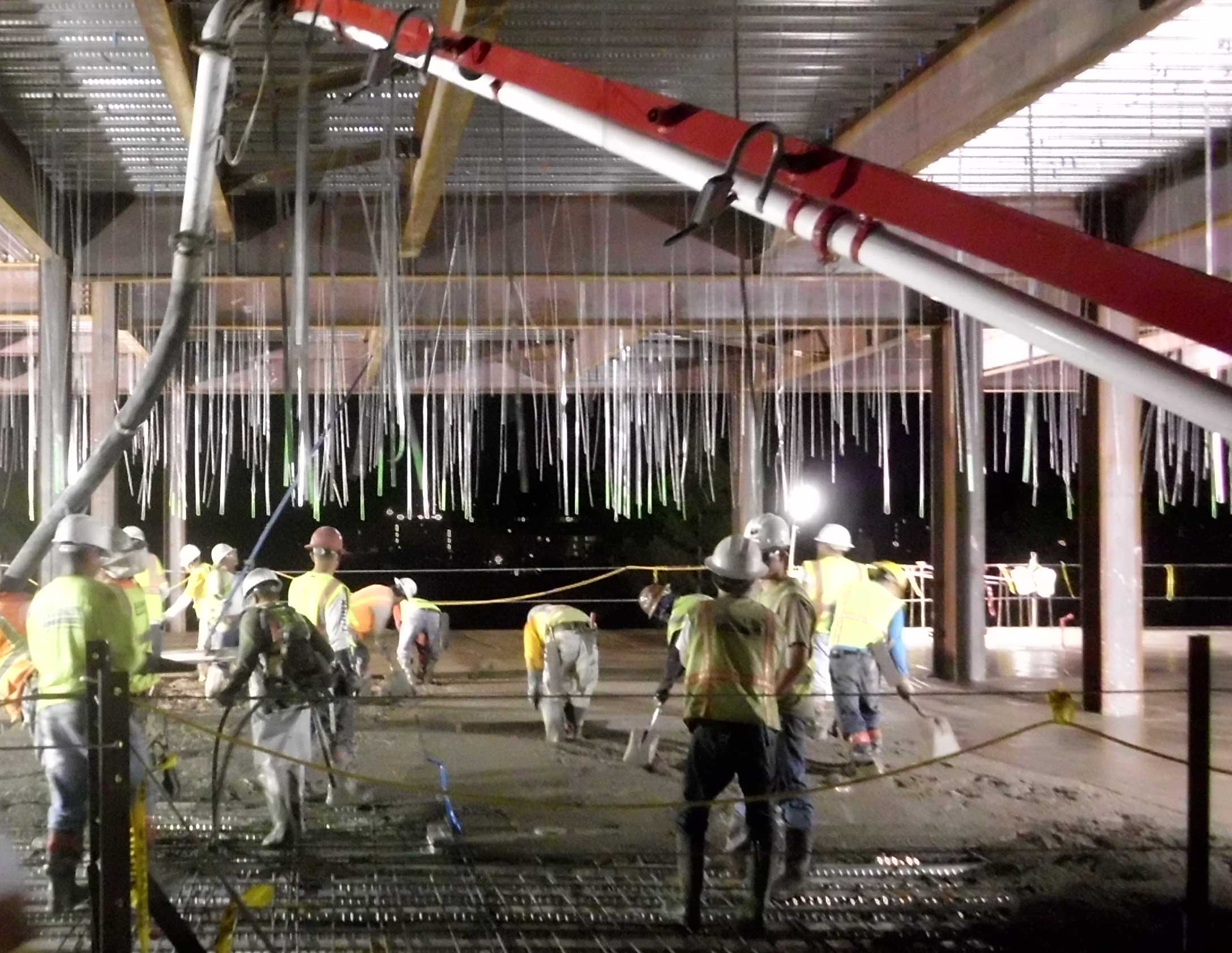
The project required 10,000 cubic yards of concrete, and Hanson Ready Mix, the concrete supplier, chose Arcosa’s Frazier Park aggregate to meet the stringent California fire, seismic, and energy efficiency codes. Hydrolite’s permeability and thermal resistance also contributed to the building’s sustainability efforts, further supporting the LEED certification.
Construction and Performance
The lightweight expanded clay material used in the Warren J. Baker Center’s construction offer several critical benefits:
- Strength and durability: Hydrolite’s lightweight nature made it ideal for construction on weak soil, reducing the overall load on the structure.
- Thermal resistance: The aggregate provided excellent insulation when used under flooring, helping the building meet energy efficiency standards.
- Sustainability: As an environmentally friendly material made from natural clay, Hydrolite was a perfect fit for the project’s sustainability goals.
Produced by firing natural clay at 1100-1200°C in a rotating kiln, the rounded pellets of 0-32mm in size have a dry bulk density of approximately 350 kg/m³, making them ideal for lightweight construction while still maintaining strength and durability.
Environmental Impact and Sustainability
The Baker Center’s design and construction focused heavily on sustainability. The use of Arcosa’s Hydrolite® aggregate was a key factor in achieving this goal. Hydrolite is primarily composed of naturally occurring clay, making it environmentally friendly, durable, and resistant to chemical attacks, rot, or frost. The aggregate’s long life span also ensures minimal maintenance and continued performance in a wide range of applications, including lightweight concrete blocks and water filtration systems.
The Warren J. Baker Center for Science and Mathematics stands as a symbol of sustainability and innovation at Cal Poly San Luis Obispo. By utilizing Arcosa Lightweight’s Hydrolite® expanded clay aggregate, the project successfully met stringent environmental, fire, and seismic requirements while reducing the building’s overall load and supporting its LEED-Gold certification. Recognized by the Center for the Built Environment as an Award Winner in 2017, the Baker Center is a model for future sustainable campus developments.