Key Insights
Quick Facts
- Name: Market Square Tower
- Location: Houston, Texas
- Customer: CEMEX
- Client: Jackson & Ryan Architects
- Size: 502 feet (153 meters), 40 stories
- Our Solution: Structural lightweight concrete reduced the dead load, allowing the building to reach 40 stories despite geotechnical challenges.
- Why Lightweight Works: The lightweight concrete provided essential fire resistance, seismic response improvements, and reduced reinforcing steel requirements, making the building structurally sound.
Final Results
-
Market Square Tower became the tallest residential building in downtown Houston upon its completion in 2017 and is famous for its Sky Pool, which offers breathtaking views.
Key Quote
Context:
- Considerations: The use of lightweight concrete dispelled myths about its pumpability and high compressive strength in tall buildings.
- Lessons Learned: Prewetting lightweight aggregate is critical to ensuring consistency and reducing slump loss when pumping to great heights.
Learn how Arcosa Lightweight continues to play a crucial role in overcoming geotechnical challenges for high-rise buildings.
Structural Lightweight Concrete Elevates Houston’s Skyline
Market Square Tower, a 40-story residential building, rises 502 feet over downtown Houston, Texas and features 463 luxury apartments. The impressive height of the skyscraper was made possible through the use of structural lightweight concrete, which allowed the tower to reach its maximum height despite challenging geotechnical conditions.
Market Square opened in 2017 as the tallest residential building in downtown Houston. It remains famous for its Sky Pool—a glass-bottom pool that extends 10 feet beyond the building’s edge—offering both breathtaking and thrilling views.
Market Square Tower was designed by Jackson & Ryan Architects, with Guy Jackson, AIA, Principal Emeritus, leading the project. Jackson explains that geotechnical conditions at the site would have limited the building’s height if traditional materials had been used. “It’s a 40-story building next to a 12-story garage I did back in the 80’s and that presented some geotechnical issues with the foundations.”
“We couldn’t go as tall as we did go without using lightweight structural concrete for the frame. We’d be three or four floors shorter if we’d used conventional concrete,” he added.
By reducing the dead load, Arcosa Lightweight’s structural concrete made it possible to overcome these challenges, enabling the tower to rise to its full 40 stories.
Bill Wolfe, Marketing & Technical Manager at Arcosa Lightweight, explains that structural lightweight concrete not only solves geotechnical challenges but also offers design flexibility and substantial cost savings, including reduced dead load, improved seismic response, enhanced fire ratings, and less reinforcing steel. These combined benefits made Arcosa’s lightweight aggregate the perfect choice for Market Square Tower.
Dispelling the Myths About Pumping Lightweight Concrete
This project also dispels a common myth: that lightweight concrete can’t be pumped to great heights. “We have example after example of projects where we’ve done just that,” says Wolfe. “We’ve pumped concrete to over 50 stories in Chicago, and 60 stories in Los Angeles at the Wilshire Grand Project. These examples show that lightweight concrete can be pumped successfully to great heights.”
Wolfe emphasized that Arcosa’s lightweight concrete performs exceptionally well in high-rise applications, where both height and weight are critical factors. In addition to its pumpability, lightweight concrete provided other vital benefits for the Market Square Tower, such as improved fire resistance and reduced structural load, which allowed the building to be taller without increasing foundation stresses.
609 Main at Texas: Another Success Story
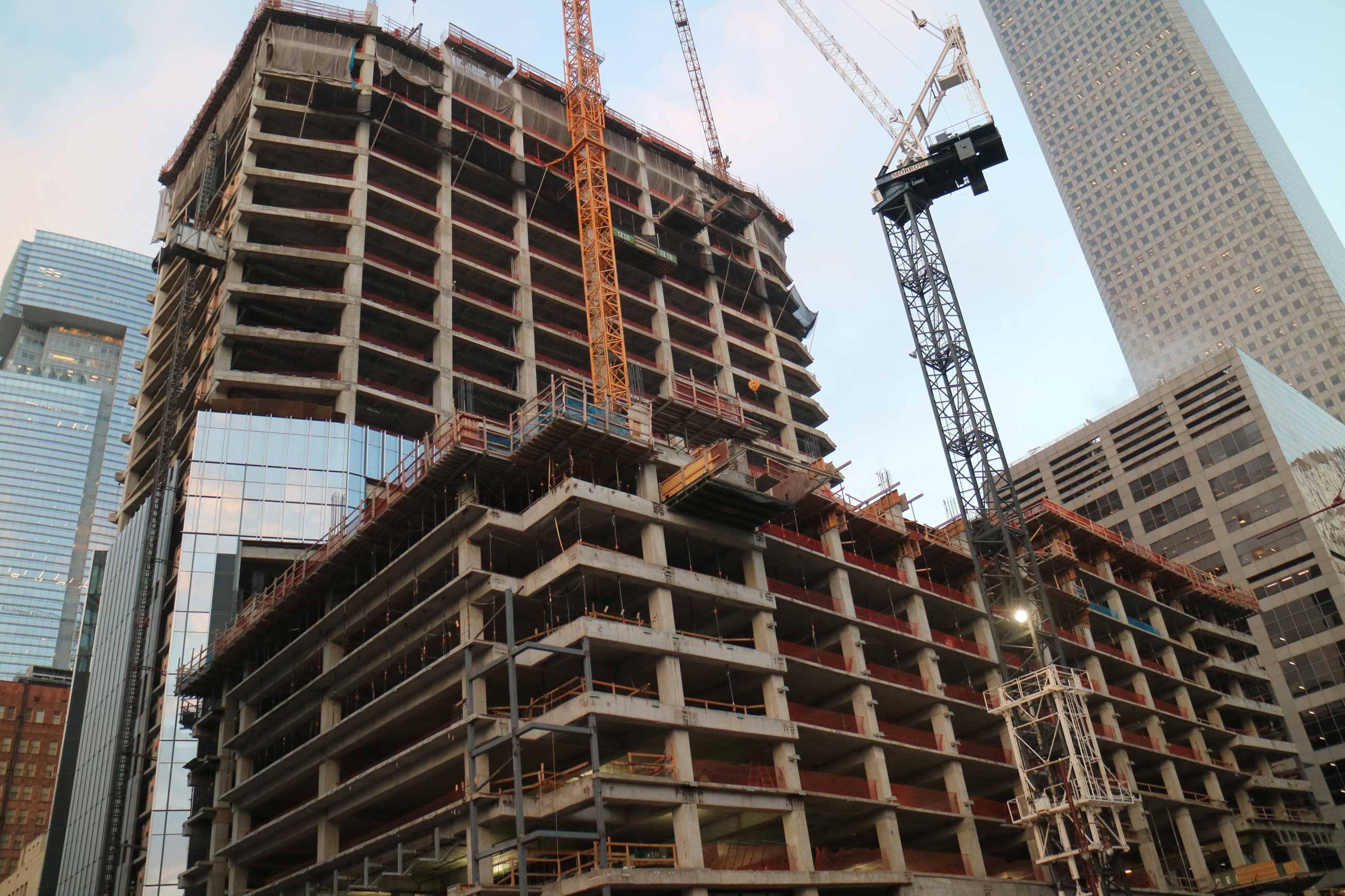
Wolfe also notes another Houston high-rise project, 609 Main at Texas, pumped lightweight concrete several stories and obtained an extra benefit from the use of the product: achieving high compressive strengths.
“What’s unique about 609 Main was the project’s specified compressive strength of the lightweight concrete,” Wolfe says. “It goes as high as 7,200 psi which dispels another myth about lightweight concrete that you can’t achieve high compressive strengths.”
As Wolfe explains, modern pumping technology, combined with a better understanding of how to use lightweight aggregate effectively, has made these advancements possible. Prewetting the lightweight aggregate is a crucial step, ensuring the material doesn’t absorb water during pumping, which helps maintain consistency and minimizes slump loss.
The Market Square Tower and other high-rise projects in Houston showcase the value of Arcosa’s lightweight aggregate in overcoming geotechnical challenges and allowing buildings to soar to new heights. With improved performance, enhanced fire resistance, and the ability to reach high compressive strengths, lightweight concrete continues to be a key material for innovative high-rise construction.